Material Innovation · Private Label
Biodegradable Sunglasses: Materials, Manufacturing and Private-Label Opportunities
Biodegradable sunglasses can create meaningful differentiation, but only when the material claim is accurate, the frame performs well and the end-of-life story is clearly defined.
Biodegradable sunglasses sit at the intersection of material innovation and growing demand for lower-impact products. The opportunity is real, but the terminology can be confusing: bio-based, biodegradable, compostable and recycled do not mean the same thing.
A credible collection needs a documented material, a durable product design and carefully qualified communication. DMARJAN helps brands move from material exploration to sample and production through its Shenzhen factory.
Understand the Material Vocabulary
- Bio-based describes feedstock origin and does not automatically define disposal.
- Biodegradable requires specific conditions and a defined test context.
- Compostable normally refers to performance under stated industrial or home-composting conditions.
- Recycled content describes input material, not biodegradation.
Brands should avoid combining these terms unless supplier evidence supports each statement.
Balance End-of-Life Ambition With Product Life
Sunglasses are durable goods. They must withstand handling, heat, perspiration, lens fitting and repeated opening. A responsible material choice should not reduce useful life simply to produce a stronger headline.
The development brief should set both environmental goals and performance expectations.
Evaluate Colour, Finish and Construction
Plant-derived and alternative materials may behave differently during machining, polishing, bonding or colour development. Frame thickness, hinge integration and component selection must be developed around the chosen material.
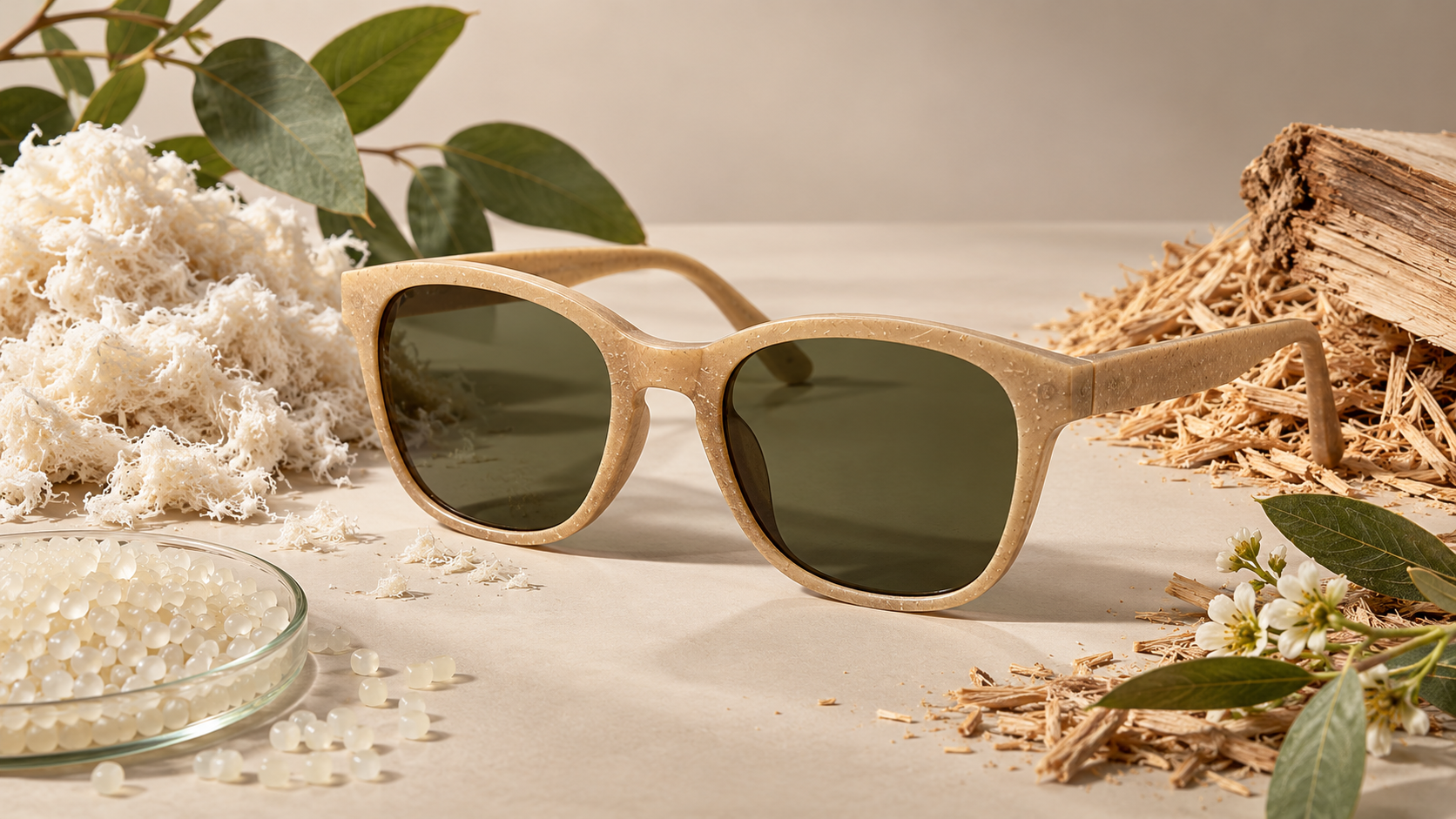
A physical prototype allows the brand to judge the finished product instead of approving a raw pellet or sheet in isolation.
Verify Every Claim for the Exact Product
Ask for available technical information that identifies the material grade and the conditions behind any biodegradation or compostability statement. A claim for raw material should not automatically be extended to the entire finished product, which also contains lenses, hinges, screws and coatings.
Final packaging and marketing claims should be reviewed for the destination market by qualified specialists.
Choose a Private-Label Route
ODM can be useful when a suitable developed frame can accept the selected material and brand customisation. OEM is appropriate when the material story, construction and silhouette require a more original product.
In either route, agree on the material, colour, dimensions, components, lenses, branding and packaging before bulk production.
Design the Complete Lower-Impact Experience
Consider repairability, replaceable components, packaging weight and clear care instructions. A strong sustainability strategy extends beyond the frame front and supports a longer, better product life.
A biodegradable claim is only as strong as the conditions behind it—and the product is only as sustainable as its complete useful life.
Frequently Asked Questions
Are all plant-based sunglasses biodegradable?
No. Feedstock origin and end-of-life behaviour are different properties. Confirm the exact material documentation.
Can lenses and hinges biodegrade with the frame?
The complete product contains multiple materials. Claims should distinguish the frame material from lenses, metal components and coatings.
Can DMARJAN develop a private-label sustainable collection?
DMARJAN can review the product direction, material options, sampling and manufacturing plan based on the project requirements.
Explore Your Sustainable Material Direction
Tell DMARJAN what environmental benefit and market position you want the collection to achieve, and we will help define a practical development path.